
2SLGBTQIA+ inclusion at Canadian Blood Services
Apology to 2SLGBTQIA+ communities
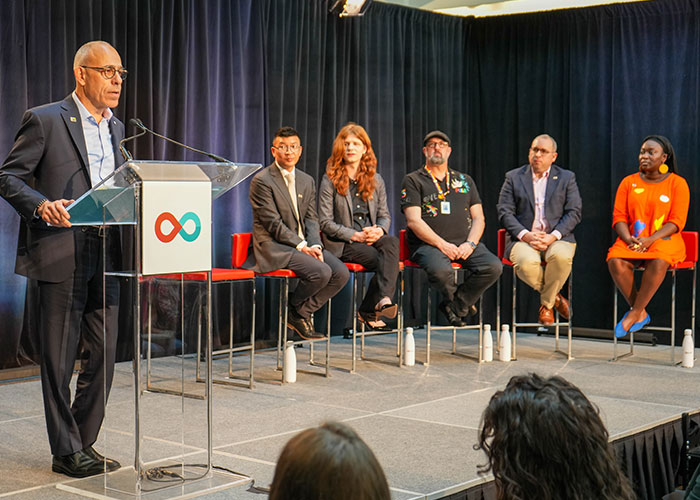
On May 10, 2024, Canadian Blood Services issued a public apology to 2SLGBTQIA+ communities across Canada, acknowledging the harms experienced because of a former donor eligibility policy, which prevented all sexually active men who have sex with men and some trans people, from donating blood and plasma.
The apology was developed in close collaboration with 2SLGBTQIA+ individuals, organizations and community advocates and reflects how the former policy contributed to discrimination, homophobia, transphobia and HIV stigma within Canadian society, for many years.
The apology to 2SLGBTQIA+ communities was a necessary step in our journey to build trust and repair relationships with those impacted by the former donor eligibility policy.
Sexual behaviour-based screening for blood and plasma donation

Since September 2022, sexual behaviour-based screening has been in place at Canadian Blood Services. All blood and plasma donors are now asked the same questions to determine eligibility, regardless of their sex assigned at birth or sexual orientation.
During screening, people are asked if they’ve had new and/or multiple sexual partners in the last three months. If the answer is yes, they are then asked if they’ve had anal sex.
- People who have anal sex and have had the same sexual partner for three months — or people who have multiple partners and have not had anal sex with any of those partners in the last three months — will be able to proceed with the donation process.
- People who have had anal sex in the last three months with a new partner — or with multiple partners — will be required to wait three months from when they last had anal sex to donate.
The three-month wait is in place to reduce the chance that our tests may miss any recently acquired infections.
More information and FAQs about sexual behaviour-based screening can be found here.
Engage with us
Share your feedback and questions with us by contacting engage@blood.ca or using our anonymous engagement tool.
Thanks to 2SLGBTQIA+ advocacy, consultation and collaboration, we’re building more inclusive donation processes and spaces, together, and we’d love to know what you think. Your participation in this short anonymous survey will help us learn how we can show up for you better. Don’t hold back!
Frequently asked about topics
Below you’ll find information about topics most frequently asked about by 2SLGBTQIA+ donors, employees and community members.
Don’t see your question answered below? Explore our extended FAQs related to sexual behaviour-based screening or reach out to us at engage@blood.ca.
Accessibility in donor centres
We are committed to making our spaces as accessible and inclusive as possible, including for donors with disabilities.
- We arrange for certified sign language interpreters to accompany donors who are Deaf, deafened or hard of hearing through the donation process.
- Donors who are blind, partially sighted or who have low vision can request a Canadian Blood Services employee read any required information during the screening process and assist them to the donation floor, if required.
- Service animals may accompany donors in permanent donor centres throughout the donation process.
- We unfortunately don’t have height-adjustable donation beds, and our employees aren’t trained to transfer donors onto our donation beds. However, donors may bring a support person to their appointment to assist them onto a donation bed.
More information about accessibility practices in our donor centres can be found here.
Condom use
Condom use, while an excellent sexual health practice, isn’t considered an evidence-based method of screening blood donors because condoms are not always effective and can break or slip.
Our donor screening questionnaire is designed to be applied as broadly as possible to screen many potential donors. It’s not comprehensive in asking about safe sexual practices, such as condom use.
Organ and tissue donation
The eligibility criteria for organ and tissue donation are different than those for blood and plasma donation. Federal regulations and standards are followed for organ and tissue donor eligibility and donor screening is conducted by the provincial organ and tissue donation programs.
Although Canadian Blood Services does not determine organ and tissue donor eligibility, we’re committed to supporting ongoing work to make organ and tissue donation and transplantation more inclusive. We firmly believe that eligibility to donate biological products should not be based on sexual orientation.
Our role in the organ and tissue landscape in Canada is to facilitate collaboration in the donation and transplantation community and support the development of leading practices, professional education and public awareness. One such example is the work conducted in cooperation with leading 2SLGBTQIA+ experts to develop and launch a professional education program designed to increase inclusion and belonging of 2SLGBTQIA+ folks in the organ and tissue donation and transplantation system.
The curriculum is now available and offers an interactive educational intervention with the aim of increasing the capacity of donation and transplant teams to provide inclusive care to 2SLGBTQIA+ people.
PrEP (pre-exposure prophylaxis)
Pre-exposure prophylaxis, or PrEP, is a highly effective combination of medications that, when taken as directed, prevents HIV transmission through sex for the person taking it. Post-exposure prophylaxis, or PEP, may be prescribed to people who are HIV negative, who have had a potential exposure to HIV in the last 72 hours.
PrEP is widely used by many people, including people in 2SLGBTQIA+ communities and is a celebrated and recommended way to maintain sexual health. The challenge facing blood operators like Canadian Blood Services, is that these medications can affect the accuracy of our blood screening tests; specifically, our tests’ ability to detect breakthrough infections. Because Canadian Blood Services relies on accurate performance of HIV tests as part of our multi-layered approach to safety, people who use PrEP/PEP are not currently eligible to donate.
If you have recently stopped taking PrEP, or were recently prescribed PEP, you’ll be asked to wait four months after your last dose of oral medication or two years after your last injectable dose, to donate.
Given the health and wider benefits of PrEP, we are actively reviewing scientific research and evidence in this area to better understand the impact of PrEP/PEP on HIV testing. Through this work, we’re seeking to determine how we can make inclusive changes to donor screening for PrEP, while maintaining the safety of the blood system.
Receptive vs. insertive anal sex
Receptive anal sex has a higher chance of HIV transmission per sex act than insertive anal sex. However, when we conducted studies asking donors about receptive anal sex, the term was not well understood, and the question was inconsistently answered.
For the safety of our blood and plasma supplies, it’s important that our donor screening criteria are easily understood by all donors, which is why we made the decision to ask about anal sex generally as part of sexual behaviour-based screening.
Sex work
People who have engaged in sex work are currently asked to wait 12 months after they last received money or drugs in exchange for sex before donating blood or plasma. For the purposes of assessing a person’s eligibility for donation, when we ask about sex work, we define sex as having oral, vaginal, and/or anal intercourse for money or drugs.
Canadian Blood Services’ goal is to ensure the safety and sufficiency of Canada’s blood and plasma supply while increasing participation and maximizing inclusion in Canada’s Lifeline. We are actively reviewing current criteria against the latest scientific evidence.
Sex with an HIV+ partner
People who have recently had sex with an HIV-positive partner (including those who are taking antiretroviral therapy and have undetectable viral loads) are asked to wait 12 months after the last sexual contact, before donating blood or plasma. For the purposes of assessing a person’s eligibility for donation, for this question we define sex as oral, vaginal, and/or anal intercourse.
Canadian Blood Services’ donor screening process focuses on each donor’s individual health, behaviours, and medical history. We do not ask donors to provide information about someone else’s medical status or medications and cannot rely on third-party health information to determine eligibility.
Canadian Blood Services’ goal is to ensure the safety and sufficiency of Canada’s blood and plasma supply while increasing participation and maximizing inclusion in Canada’s Lifeline. We are actively reviewing current criteria against the latest scientific evidence.
Stem cell donation
2SLGBTQIA+ people are welcome and encouraged to join the Canadian Blood Services’ Stem Cell Registry. Anyone on the registry who is identified as a potential match receives the same gender-neutral, behaviour-based screening questions to determine eligibility — regardless of their sex assigned at birth or sexual orientation.
All potential stem cell donors are now asked if they’ve had anal sex with a new partner or multiple partners in the last three months. No matter how you respond, you will still be eligible to donate if you meet the required criteria. Please note, however, that Canadian Blood Services is mandated to provide your response, without disclosing your personal identity, to the centre requesting stem cells for their patient.
The patient's health care team will ultimately make the decision about whether to proceed with the matching donor, not Canadian Blood Services. These decisions are based on several factors, including donor age and overall health.
Please be aware that all individuals are asked for their sex assigned at birth when first registering to join the Stem Cell Registry, as biological sex helps inform decision making related to donor-patient matching and outcomes.
Trans and gender diverse donor experiences
Improving the donation experience for trans, non-binary, Two-Spirit and gender diverse donors is an urgent priority of ours. We’ve been actively working on several short- and long-term changes to our registration and screening practices, in consultation with impacted communities.
Changes implemented to date include:
- All potential blood, plasma and platelet donors, regardless of sex at birth or gender identity, are asked if they have been pregnant in the past six months.
- All potential platelet and multi-plasma donors, regardless of sex at birth or gender identity, are asked the pregnancy question above, as well as if they’ve ever been pregnant, miscarried or had an abortion.
- Trans donors are no longer asked if they’ve had gender-affirming surgery.
- We no longer ask donors to verbally state their gender at each donation appointment.
- Trans and gender diverse donors with a binary gender can now register in their gender, and can make this change themselves in the GiveBlood app.
U=U (undetectable equals untransmissible)
It is incredible that HIV care has reached a point where people’s viral loads can be undetectable.
However, undetectable equals untransmissible (U=U) only applies to sexual transmission of HIV. Even when a person who is HIV-positive has an undetectable viral load, the virus could still potentially be transmitted through blood transfusion.
The chance of transmission is much higher with a unit of blood, due to the large volume of blood being transfused and the relatively higher total amount of virus present. For this reason, a person who is HIV-positive, even with an undetectable viral load, is not eligible to donate blood or plasma.
Pride festivals and events
Since 2023, Canadian Blood Services has participated in Pride events across Canada as part of our continued efforts to repair relationships and build trust with 2SLGBTQIA+ communities.
We’ve met some incredible, newly eligible donors, advocates, and allies over the past several years and have worked to foster awareness of sexual behaviour-based screening, our apology to 2SLGTBQIA+ communities and other inclusion initiatives that matter deeply to the community.
This year, Canadian Blood Services employees and volunteers plan to be at the following Pride festivals and events — drop by to ask questions, learn more or just say hello!
June:
- Pride Winnipeg: June 6–7
- Queen City Pride, Regina: June 13
- Pride Toronto & parade: June 27–28
- Saskatoon Pride: June 27–28
August:
- Edmonton Pride: August 22–23
- Capital Pride, Ottawa & parade: August 29–30
July:
- Victoria Pride: July 12
- Halifax Pride: July 18
- London Pride: July 18–19
- St. John's Pride: July 19
September:
- Calgary Pride: September 5–6

Our community partners and advisors
2SLGBTQIA+ Advisory committee
The Canadian Blood Services 2SLGBTQIA+ advisory committee was established in 2022, prior to the implementation of sexual behaviour-based screening. Its mandate is to provide ongoing advice and input on 2SLGBTQIA+ inclusion efforts, while supporting broader engagement of 2SLGBTQIA+ communities within Canadian Blood Services’ work.
Membership consists of representatives from 2SLGBTQIA+ civil society organizations and Canadian Blood Services employees from 2SLGBTQIA+ communities.
You can send your views and feedback directly to the advisory committee here.
Wisdom2Action
Wisdom2Action is a social enterprise and consulting firm supporting civil society organizations and governments that provides input and guidance to Canadian Blood Services on 2SLGBTQIA+-related issues and activities.
Wisdom2Action also manages the logistics and engagement process of the Canadian Blood Services 2SLGBTQIA+ advisory committee.

Pride at Work Canada
Through Canadian Blood Services’ partnership with Pride at Work Canada, our employees have access to many resources, e-learning and networking opportunities, as well as member-only events that explore and address ongoing issues facing 2SLGBTQIA+ people and communities in Canadian workplaces.

2SLGBTQIA+ microgrant program
With the guidance of our 2SLGBTQIA+ advisory committee, we launched a microgrant program in 2024, funded by generous gifts from Canadian Blood Services’ financial donors. The microgrants aim to produce engaging and informational content about blood and plasma donation, by 2SLGBTQIA+ communities, for 2SLGBTQIA+ communities.
Below is a summary of the awardees to date, along with examples of some of the projects and content that have been produced to date.
Round one awardees: National and large regional 2SLGBTQIA+ organizations
- pflag Canada created a series of social media and printable assets they are sharing broadly through their networks.
- Pride at Work Canada hosted public webinars (in English and French) to build awareness of recent eligibility criteria changes and other 2SLGBTQIA+ inclusion initiatives. They also created a downloadable resource called Progress on blood donations for 2SLGBTQIA+ communities.
- Community-Based Research Centre (CBRC) produced a fact sheet called “Breaking it down: Understanding new blood donation criteria for 2S/LGBTQIA+ people” and social media content about recent donation criteria changes and our relationship building efforts with 2SLGBTQIA+ communities.
- ChromaNB produced testimonial videos featuring newly eligible 2SLGBTQIA+ donors and created printable materials outlining the recent donation criteria changes and our relationship building efforts with 2SLGBTQIA+ communities. These resources were shared on social media, in person, and on their website.
- Comité francoqueer de l’Ouest (CFQO) produced several resources for French-speaking 2SLGBTQIA+ people, including a dedicated web page, a webinar, and a series of social media posts to build awareness of recent donation criteria changes and emphasize the importance of blood donation.
Round two awardees: Local 2SLGBTQIA+ organizations
- The519 hosted three live information sessions with program staff, Health Justice peer leaders and the public to increase awareness about eligibility changes for 2SLGBTQIA+ communities.
- Saving Lives with Pride updated their webpage and created an infographic called Working Towards a More Inclusive Blood System in Canada.
- The ArQuives created an exhibition to educate about the history of 2SLGBTQIA+ blood donation and updated donor eligibility in Canada.
- Peers Alliance hosted a social media awareness campaign about donation eligibility changes and in person education sessions with their networks.
- Spectrum Waterloo created an online video called “Blood Donation and the 2SLGBTQIA+ Community”.
- Sher Vancouver conducted in-person awareness sessions about the eligibility changes for 2SLGBTQIA+ communities. They also created a social media awareness campaign called “Donate Blood Save Lives”.
- Health Initiative for Men (HIM) hosted an in-person community dialogue session to learn more about the eligibility criteria changes for 2SLGBTQIA+ communities.
- St. John’s Pride and QuadrangleNL collaborated on a virtual panel discussion that focused on the apology and revised donation criteria, as well as other issues pertaining to 2SLGBTQIA+ healthcare.
The 2SLGBTQIA+ microgrant program is funded by generous financial donors. To support this ongoing work with a financial donation, visit below.
News, stories and public statements

Our commitment to diversity, equity, inclusion, and reconciliation
At Canadian Blood Services, social responsibility is core to our purpose. It is embedded in our founding principles and has driven our evolution as Canada’s Lifeline.
We have a deep responsibility to the people and diverse communities across the country who count on us, our employees, the partners who collaborate with us and the planet we inhabit together.
As a not-for-profit, charitable organization providing the life essentials for transfusion and transplantation to patients across the country, we’re committed to acting ethically, communicating transparently and earning the trust that Canadians and all people across this land have invested in us. They expect us to do the right thing — and that’s what we expect of ourselves.