Reconciliation Action Plan
Reconciliation is a process of learning, exploration and decolonization. It’s building and sustaining respectful relationships with First Nations, Inuit and Métis Peoples, while remaining grounded in honesty, humility and a genuine commitment to change.
For Canadian Blood Services, reconciliation is integral to our mission.
Our Reconciliation Action Plan (RAP) was developed in consultation with Indigenous and non-Indigenous employees, Elders, Traditional Knowledge Keepers, and Indigenous advisors. It serves as our guide as we navigate our steps on this reconciliation journey and holds us accountable to our actions and commitments.
This work aims to help us to cultivate and nurture meaningful relationships with Indigenous communities, embed Indigenous perspectives within our workplace, and improve First Nations, Inuit and Métis representation amongst our donor base through respectful engagement and collaboration.
Our key actions and commitments
Our Reconciliation Action Plan is a living document. Focused on evolving Canadian Blood Services into a culturally safe, equity-driven organization, which is actively working to identify and address barriers to First Nations, Métis, and Inuit participation in Canada’s lifeline.
The plan centers on four key focus areas:
- Acknowledgement & sharing
- Learning & education
- Strategies & planning
- Engagement & participation
Our ongoing work to advance the Reconciliation Action Plan, includes the following actions:
- Continuous learning and education about Indigenous cultures and histories, cultural safety and cultural humility.
- Creation of culturally safe spaces and opportunities for dialogue with and among Indigenous employees.
- Engagement with Indigenous Peoples, communities and organizations to identify collaboration opportunities and establish partnerships.
Our progress to date
In 2026, Canadian Blood Services reviewed the progress made since launching its Reconciliation Action Plan. First Peoples Group, with input from the Indigenous Council, collaborated with us throughout this process, reflecting on what has been accomplished and, more importantly, identifying the steps needed to strengthen our efforts moving forward.
Canadian Blood Services has made steady progress embedding reconciliation across our organization since 2020. We’ve started to action nearly two-thirds of the 33 action items identified in the Reconciliation Action Plan.
As we look back on four years of implementation, three priorities will shape the next phase of our reconciliation work:
- Implementation planning and accountability
- Measurement and evaluation
- Engaging Indigenous employees
They will guide the refresh of the Reconciliation Action Plan as we reflect on what we’ve learned and help us embed reconciliation more fully across Canadian Blood Services.
Acknowledgements
We acknowledge that the work of Canadian Blood Services spans many Territories and Treaty areas across the country, and we are grateful for the Elders and Traditional Knowledge Keepers who guide us in this important work.
Importantly, we are grateful for the leaders and Elders with First Peoples Group and the members of the Indigenous Council, both current and former, who have supported us and guided us on this work.
We recognize the land and waters that inspire our work and offer gratitude to those Indigenous Peoples on whose territory we work, live and play.

Gifts from Indigenous artists
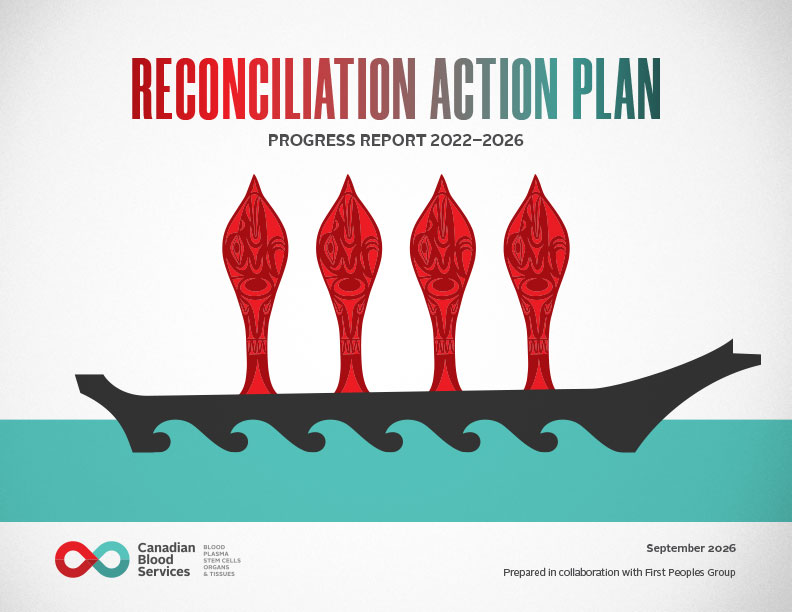
In many Indigenous cultures, the practice of gift giving has unique significance. The tradition shows respect to the receiver of the gift and is a way to show appreciation of knowledge that is exchanged. The artwork below has been gifted to Canadian Blood Services by Indigenous artists to signify that we are ready to begin our truth and reconciliation journey.


“We are incredibly grateful to the Indigenous staff, community members, Elders and consultants who are guiding us in this critical work. We know that the road to reconciliation will take time and ongoing commitment and Canadian Blood Services is devoted to this pathway of humility, awareness, dialogue and action.”
Dr. Graham Sher, CEO